NEWMARKET LAWYER FAKED JUDGES’ ORDERS AND WE ARE LEFT TO CLEAN UP THE MESS

A former York Region lawyer “maintained an elaborate web of lies for years” as he gave his clients fake judicial orders and continued taking their money even though he was no longer working on their cases, a judge has found.
Ontario Court Justice Sandra Bacchus convicted Adam White of fraud and uttering forged documents in December in Newmarket; her written reasons were released earlier this month. In doing so, she took into account his testimony that he was dealing with mental health issues, but rejected his claims that he either didn’t provide the fake documents or didn’t recall doing so. A former president of the York Region Law Association, White was suspended by the Law Society Tribunal in 2023 and his licence was revoked the following year over the forgeries.
In one instance, White provided a client who was suing for wrongful dismissal with fake documents including orders from a judge and an email from the opposing lawyer offering to settle, when in reality the case had already been dismissed without the client’s knowledge.
The fake letter from opposing lawyer Jessica DiFederico, dated Dec. 16, 2019, and including her law firm logo, offered to settle the case for $85,000 — “this is in excess of our client’s last offer, not as an admission of liability but as an offer to see this matter resolved.”
The letter partly contributed to the client’s desire to increase the amount of damages he was seeking. What he didn’t know was that his case had been dismissed in June 2019. He testified he only learned of that fact when he went to the courthouse in March 2023 to inquire about its status; not only was he told that the case had ended years ago, but that there was an outstanding costs award against him for $8,000.
A fake letter from an opposing lawyer in December 2019 offering to settle, when in reality the case had been dismissed months earlier.
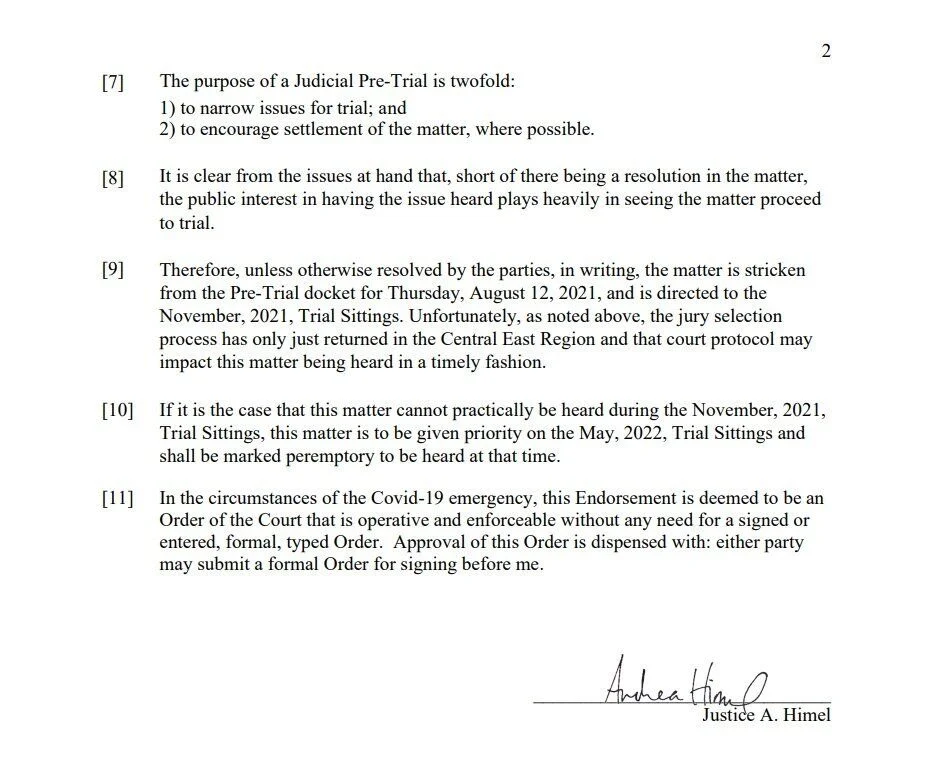
It was a surprise to the client, given that White had been emailing him throughout 2020 and 2021 suggesting the civil case was still active. White had also provided him with an endorsement that appeared to be signed by Superior Court Justice Andrea Himel and included a court logo, in which the judge purportedly ruled that the trial would be heard in November 2021, but may be impacted by delays related to COVID-19.
“The jury selection process has only just returned in the central east region and that court protocol may impact this matter being heard in a timely fashion,” says the fake Himel endorsement. “If it is the case that this matter cannot practically be heard during the November 2021 trial sittings, this matter is to be given priority on the May 2022 trial sittings.”
In November 2022, White sent his client another fake Himel endorsement, punting the trial to spring 2023. The client testified he paid White between $15,000 to $20,000 to handle his lawsuit; he said he paid $7,000 after the case was dismissed without his knowledge in June 2019.
Fake Himel endorsement
A fake endorsement with the signature of Superior Court Justice Andrea Himel.
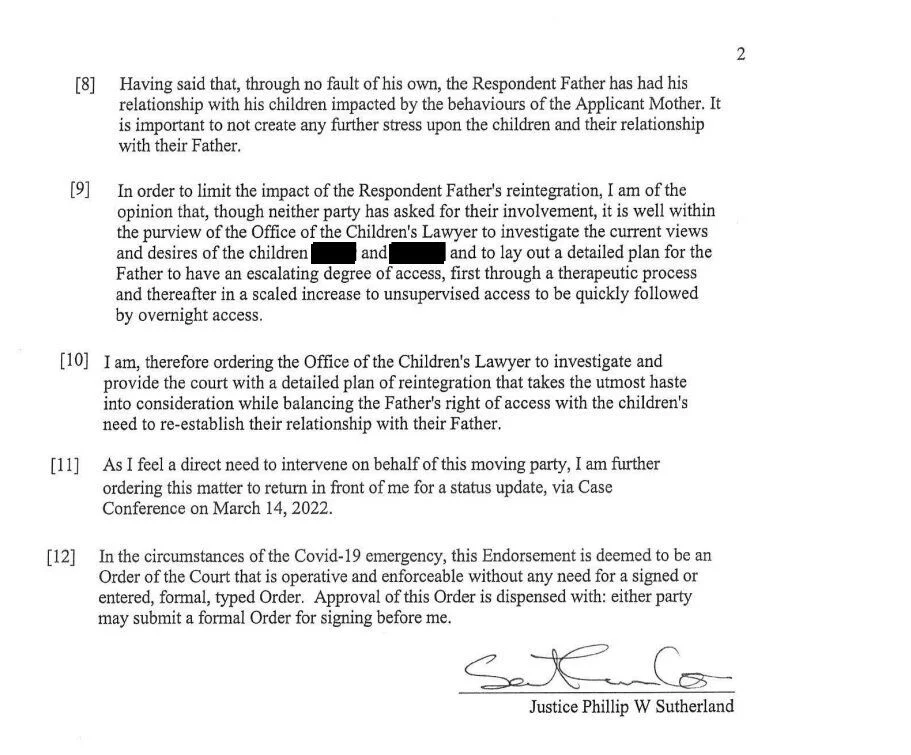
In the second instance, White provided a number a fake judicial endorsements while representing a man in a child custody case between 2020 and 2022. The client testified receiving one of the endorsements from White in his Keswick office, with White telling him it was positive and the judge “appeared to be favouring his side.”
In the fake endorsement purportedly signed by Superior Court Justice Phillip Sutherland in February 2022, the judge wrote that it was “completely untenable” that the mother was frustrating the man’s access to his children, and ordered that the Office of the Children’s Lawyer investigate the current views and desires of the children to facilitate the father’s reintegration into their lives.
The man’s professional relationship with White ended in October 2022 when he was served with a contempt motion by his ex-wife’s lawyer for missing a court date he had no knowledge of. The man’s mother had been covering his legal fees, and testified she paid White an initial $5,000 retainer fee followed by several payments totaling over $11,000.
The judge specifically found that a payment of $2,825 made by the mother to White in June 2022 at the lawyer’s request, for what White descried as “future actions,” was money received “for court proceedings that had not occurred and were not scheduled” in 2022.
“She testified that she went to Mr. White’s office on multiple occasions to find out what was going on with the case when he was not replying to the emails, texts or phone calls, either she or her son sent to Mr. White,” Bacchus wrote in her judgment.
“She testified that on other occasions, Mr. White met her at the door of his office and told her he was working on it. However, on more than one occasion when she went to Mr. White’s office, she testified that he would come out of his office and say, ‘it’s good news,’ and then hand her and her son a document.”
White represented himself at trial. Testifying in his own defence, he said he didn’t have the required intent to defraud his clients due to mental health struggles. Bacchus found that he testified in “an incredible and unreliable fashion.” For example, when asked if he had sent a particular email, his response was typically “that he could not confirm, but he also could not lawfully or legally deny,” the judge wrote. And when asked about a particular fake judicial endorsement, he testified that “if he received an endorsement, he was obligated to provide it to his client.”
She also rejected a suggestion by White that his law clerk “was principally involved in passing off these false documents” to his clients without his knowledge.
“It defies credulity that Mr. White did not provide the emails and endorsements identified in these proceedings to his respective clients or does not recall doing so,” Bacchus wrote. “They created the appearance that the matters were moving ahead while also setting up what appeared to be barriers imposed by the court.”
The judge said she took White’s mental health issues into account, but he was nevertheless guilty of one count of fraud over $5,000, one count of fraud under $5,000, and two counts of uttering forged documents. She acquitted him on two counts of attempting to obstruct justice. A sentencing hearing is scheduled for next month.
“The picture Mr. White paints of not being able to function at all, not knowing or remembering what he was doing, or how documents came about because of his deteriorated mental state, and acting with only a singular motivation and intention to survive, is not credible,” Bacchus said.
White didn’t just give his clients fake documents, the judge stated.
“He answered questions and represented to them that he was engaged in their cases,” she wrote. “And he took their money.”

OUR YOUTH JAILS CONTINUE TO ROUTINELY STRIP SEARCH YOUNG PEOPLE DESPITE THE COURT’S INTERVENTION

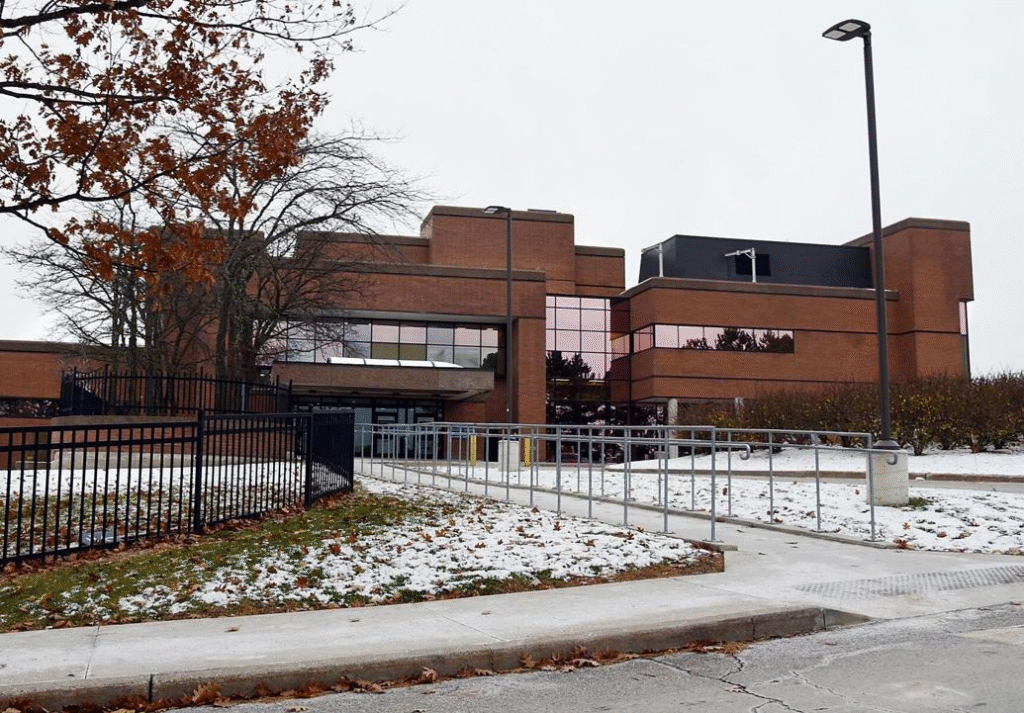
The largest youth jail in Ontario is routinely strip searching children: ‘A systemic violation’

The largest youth detention centre in Ontario is still routinely strip searching boys in their custody, the Star has learned.

Jan. 28, 2026

afwYouthJail02.JPG
In September 2024, a teen was stripped completely naked three times in a single day at the Roy McMurtry Youth Centre.Andrew Francis Wallace Toronto Star
Jennifer-Pagliaro

By Jennifer PagliaroCrime Reporter

The largest youth detention centre in Ontario is still routinely strip searching boys in their custody, the Star has learned, despite a court ruling declaring them unconstitutional. 

The revelation was made earlier this month in a Newmarket courtroom, where a 17-year-old boy, charged in an alleged carjacking incident, is now at the centre of the latest public case to see a young person challenging that treatment in custody. The boy was stripped completely naked three times in a single day at the Roy McMurtry Youth Centre. 

Three staff from the Brampton jail testified in a pretrial hearing earlier this month, according to a transcript obtained by the Star, that not only was this type of search standard procedure for the time, but since new provincial regulations were put in place this past summer, youth continue to be subjected to routine strip searches without any specific suspicion that the youth is concealing contraband, like drugs or weapons.

That appeared to shock a veteran criminal defence lawyer, Leora Shemesh, who is representing the young person.

“What I didn’t envision, and I’ll be quite frank with the Court, was that there is — there continues to be, at least my understanding of the new regulations and the new law — a systemic violation that is currently ongoing,” she said in court.

It follows a Superior Court ruling in May 2025 in the so-called girl swarm case that both being subjected to routine strip searches and being made to strip completely naked in provincial custody was unconstitutional and stating that the law authorizing it was unreasonable.

“Strip searches should be recognized as exceptional and consequential, not routine,” Justice Philip Campbell wrote. “This is especially true when they are performed on young persons who, because of their circumstances, are extremely vulnerable.”

Routine strip searches of girls in provincial custody ruled unconstitutional by Superior court judge

Gta

Routine strip searches of girls in provincial custody ruled unconstitutional by Superior court judge

Youth detention is the responsibility of the Ministry of Children, Community and Social Services in Ontario. The province directly operates five jails, including the Roy, but the majority of young people in custody are held in what are called “transfer payment” facilities run by organizations contracted by the government.

In July, the province updated the regulations to “clearly define rules and procedures for searches of staff and visitors and youth in these facilities,” an unnamed ministry spokesperson said in an emailed statement in response to the Star’s questions for this story.

The statement also said that the ministry is installing X-ray body scanners, a less intrusive search method, as a pilot project in two youth facilities, including the Roy, with plans to have them operational “in the coming months.”

The ministry said it is unable to provide further details on matters before the court.

Boys strip searched even after being in police custody

The workers at the Roy took the stand Jan. 6 to answer questions about the treatment of the boy accused in the carjacking incident after he filed a motion saying his charter rights had been violated. The Crown attorney assigned to the case has conceded that the teen’s right to not be subject to unreasonable search and seizure was violated. The boy cannot be identified under the Youth Criminal Justice Act. Neither the challenge or the charges against him have been resolved.

During the workers’ testimony the court also heard about how the jail is still performing routine searches under the new regulations, with some modifications.

The new rules continue to permit strip searching under certain circumstances but say youth should not be completely undressed at any time. The updated procedures require the head of a facility to authorize a search when less intrusive methods “would not be effective at locating contraband or is not operationally feasible” or if the person in charge “believes on reasonable grounds that the young person is carrying contraband.” The facility must also record the less intrusive search methods that were “used or contemplated” and a description of the reasonable grounds that led to the search.

In one exchange, Shemesh challenged longtime youth service worker Steven Bowes about these ongoing searches.

“As far as searching everyone for quote-unquote, contraband, there doesn’t have to be grounds for it. It’s just a standard policy. That’s how it was when you learned about it in 1997. That’s how it is now,” Shemesh said.

“There’s rules surrounding it,” Bowes replied. “That’s why you read the local operating policies and procedures, so you make sure you’re following the policy.”

“Right. But that’s what I’m asking you. So when someone comes back from court … it doesn’t matter if you think they may or may not have contraband, they’re being searched.”

“Correct.”

She pressed him further: “So when you say the grounds, there’s no real grounds. It’s just policy. The policy is, they’re going to be searched — strip searched.”

“Fair. Yes.”

Bowes also confirmed that boys are also still searched when being admitted to the facility, even if they are coming from police custody.

Shemesh later questioned Charlene Tardiel, the youth centre administrator at the Roy who said she was responsible for oversight of how the jail operates in accordance with ministry policies and legislation. She confirmed the ongoing practice.

“You believe there are still routine searches being conducted at the Roy as we sit here today?” Shemesh asked.

“Yes,” Tardiel replied.

The Roy staff testified that the teen in the carjacking case was made to strip down as an officer searched each piece of clothing, told to expose his genitals, lift them up and then turn around and bend over before he was allowed to redress.

That, the court heard, was part of the Roy’s standard practice prior to July 2025. All three staff who testified acknowledged that the new regulations now prevent total nudity and said their practice has changed. 

“So if (my client) was to go back to Roy McMurtry right now, leave court, go with you back to Roy McMurtry, he’d be strip searched?” Shemesh asked Bowes.

“Correct.”

“And the only difference would be, you’d make sure he was wearing his T-shirt when you looked at his penis and genitals and rectum?”

“Correct and that’s following the policy.”

Strip searches challenged in girl swarm case

The issue of routine strip searching in Ontario youth detention facilities became a central issue in the girl swarm case after the practice was discovered during one of the girls’ bail hearings. It led to two separate charter challenges in both the Ontario Court of Justice and Superior Court of Justice, ultimately leading to a reduction in sentences for each of the eight girls who were involved in the 2022 swarming death of Kenneth Lee.

ARTICLE CONTINUES BELOW

In his decision, Justice Campbell put the ministry and youth detention facilities on notice, saying a “constitutionally compliant strip search” going forward would involve “articulating to a manager information that gives rise to a reasonable suspicion that a detained youth possesses contraband, or that a strip search is otherwise necessary, and securing the manager’s approval.”

Routine strip searching is also being challenged in civil court with a yet-to-be certified class action filed on behalf of young people who have undergone similar treatment.

As part of that case, a legal team from Sotos LLP that is representing the youth plaintiffs submitted expert evidence about the effectiveness and psychological impact of strip searches.

Kelly Hannah-Moffat, a criminology professor at the University of Toronto, wrote in an affidavit that the new regulations “do not adequately address the core concerns surrounding routine strip searches, nor do they offer sufficient protection for youth against unwarranted or unnecessary intrusions.”

“Without a clear ban or stronger safeguards, the practice of routine strip searches is likely to persist under the guise of operational necessity or vague justifications such as ‘risk’ or feasibility,’” she wrote.

Further, she said strip searches “can inflict significant psychological harm and directly undermine the rehabilitative objectives of youth custody.”

“Despite this, institutions typically justify strip searches on the grounds of safety and security, claiming they are necessary to prevent the smuggling of contraband (e.g., weapons or drugs) and to protect detainees, staff, and visitors. However, there is no clear evidence that strip searches are effective in achieving these goals.”

PRESS RELEASE ON THE LAWYER ASSAULTED BY POLICE AT THE OSHAWA COURTHOUSE

January 26, 2026 PRESS RELEASE Re: INCIDENT AT OSHAWA COURTHOUSE My client, Sudine Riley, finished a trial in the Ontario Court of Justice late in the day on Friday January 23, 2026, and was catching up on her legal work in an interview room outside of the courtroom. Uniformed officers challenged her presence in the interview room. Ms. Riley’s head was then slammed on the desk and officers put knees in her back and neck. She was spoken to with rage, disrespect, and contempt by officers. She was forcibly removed from that room and was dragged out of the room, handcuffed, and then taken to cells in the basement of the courthouse. Her head scarf was ripped off, her skirt was raised when she was handled by officers, and her head was bleeding and her eye swollen from being slammed into the desk. She committed no offence other than being a Black woman practising law, being diligent about her commitment to the pursuit of justice. Ms. Riley is a proud member of the criminal defence bar in Ontario. She is a petite Black woman who wears a head scarf. She was handled violently and aggressively by members of police services. She is taking time to rest and heal while she considers her next legal steps. We thank you for respecting her privacy during this time. Any questions or comments can be directed through my office. Neha Chugh Neha Chugh Lawyer 613-938-0000 neha@chughlaw.ca chughlaw.ca

DURHAM REGIONAL POLICE ASSAULT LAWYER AT THE OSHAWA COURTHOUSE

DURHAM REGIONAL POLICE ASSAULT LAWYER AT THE OSHAWA COURTHOUSE

Lawyer alleges Durham police slammed her head into table, physically dragged her to cells inside Oshawa courthouse
Sudine Riley “committed no offence other than being a Black woman practising law,” reads a statement from her lawyer.
Jan. 26, 2026

“The allegations arising from this matter are being taken with the utmost seriousness,” said a statement from the Durham Regional Police Service.

Doug Ives The Canadian Press
Jacques-Gallant
By Jacques GallantCourts and Justice Reporter
A defence lawyer is alleging that Durham police officers violently assaulted her, ripped off her headscarf and took her to the cells in handcuffs at the Oshawa courthouse last Friday.
A statement issued Monday says Sudine Riley had just finished up a trial late Friday afternoon and was catching up on legal work in an interview room near the courtroom when uniformed Durham officers, working as security, “challenged her presence” in the room.
“Ms. Riley’s head was then slammed on the desk and officers put knees in her back and neck. She was spoken to with rage, disrespect, and contempt by officers,” says the statement issued by Riley’s lawyer, Neha Chugh.
“She was forcibly removed from that room and was dragged out of the room, handcuffed, and then taken to cells in the basement of the courthouse. Her head scarf was ripped off, her skirt was raised when she was handled by officers, and her head was bleeding and her eye swollen from being slammed into the desk.”
The statement goes on to say that Riley “committed no offence other than being a Black woman practising law, being diligent about her commitment to the pursuit of justice. Ms. Riley is a proud member of the criminal defence bar in Ontario. She is a petite Black woman who wears a head scarf.
“She was handled violently and aggressively by members of police services. She is taking time to rest and heal while she considers her next legal steps.”
Durham regional police confirmed to the Star that they are investigating an incident that occurred at the courthouse on Friday around 5 p.m., though did not provide further details.
“Our investigators are working closely with court services to obtain and thoroughly review all available evidence related to this incident,” the force said in a statement.
“The allegations arising from this matter are being taken with the utmost seriousness. DRPS has assigned the appropriate investigative and oversight resources to fully understand the circumstances and determine what further actions may be required.”

The incident has prompted concerns about the safety of lawyers and others who work in the Oshawa courthouse. Those concerns are outlined in a letter sent Sunday to Ontario Court Justice Lara Crawford, the local administrative judge at the courthouse, from the advocacy organization Women in Canadian Criminal Defence (WiCCD), which has nearly 800 members across the country.
“WiCCD members are understandably deeply concerned for their own safety in the Oshawa courthouse,” wrote organization president Cassandra DeMelo. “Many, if not most, of our members are racialized women who represent accused persons and many of our members do so at that courthouse.”
DeMelo asked Crawford to provide assurances that necessary measures have been taken to ensure the safety of the organization’s members working in the courthouse.
“We are taking this unprecedented step in contacting Your Honour directly because of the urgency of the situation and our members’ expressed concerns,” DeMelo wrote.
“We do also recognize that all justice system participants who work in the Oshawa courthouse have a direct and substantial interest in the issue and may also be fearful at this time.”

CASH BAIL PROPOSALS AND BAIL REFORM ARE AT BEST PERFORMATIVE POLITICS AND A WORST A DISASTER. The position of the Criminal Lawyers’ Association follow.

Ontario’s latest bail review plan a political stunt that will be ineffective and come at a high cost to taxpayers Adam Weisberg & Tonya Kent

The Ontario government never seems to tire of pumping out proposed legislation that is long on crowd-pleasing optics and short on common sense. The province’s latest half-baked e ort in this direction is a law that will require bail sureties to deposit cash for a friend or family member to be released on bail. This legislation is a political stunt that will come at a high cost to taxpayers. It promises to be ine icient and, in all probability, unworkable. It will also unfairly target the working poor and marginalized members of our communities. In contrast, those who are better o will have no trouble putting up cash to enable their family members to continue attending school or work while they await their trial. Under our bail system, it is commonplace for people charged with a crime to require a surety before they can be released. These sureties are usually relatives, friends or employers who can pass a rigorous background check. They promise to supervise the accused person and prevent breaches of their bail conditions by pledging an amount of money. Should the accused breach a bail condition or be charged with another crime, the money pledged can be seized in a process is known as estreatment. In reality, however, the province puts little e ort or resources into estreating bail, so sureties rarely face the prospect of an estreatment hearing. All the government’s new ‘cash bail’ legislation would do is create a provincial o ence targeting sureties who fail to post the cash they had pledged once the accused is released. Provincial authorities then may or may not pursue a provincial o ence charge against the surety. Will these cash deposits cause potential sureties to shy away? Will predatory lenders fill the void? With remand centres already crammed beyond capacity, how will they house impoverished o enders who will no longer secure bail? Those who su er will inevitably be petty criminals, homeless people, the untreated mentally ill and drug addicts without supports. The cost of warehousing these people until their trial – with no e ective rehabilitation programming available – will be staggering. This supposed “cash bail” plan also will create thousands of new provincial o ences that will require more court time, more provincial prosecutors, and more Justices of the Peace. This glut will have a cascading e ect. Serious criminal charges that are not tried within a reasonable time will be tossed out. Flagrant o enders who ought to face trial will o er a prayer of thanks to Premier Doug Ford as their charges are quietly dropped. Players in the court system often find ways to work around unfair or impractical policies that are foisted on them. In this instance, it is easy to foresee that judges and justices of the peace will balk. Perhaps, more accused will end up being released without the watchful eye of a surety. Some may be released on “loonie bails” – a predictable work-around in which the cash deposit is fulfilled by the deposit of a dollar. Cash bail has also proved to be ine ective in other jurisdictions. New Jersey eliminated it in 2017 and replaced it with a system similar to what we currently have in Canada. There was no increase in gun violence over the ensuing three years. Similarly, New York removed their cash bail system for non-violent felony charges and misdemeanour charges several years ago. And our Supreme Court of Canada has long recognized that no-deposit bail has the same coercive e ect as a cash bail. Estreatment remains the most fair and e ective remedy for breaches of bail – but only when there are tangible consequences for failing to comply. Actual enforcement would put money in government co ers at the same time as it deters unworthy sureties. Our justice system is based on the premise that everyone is innocent until proven guilty; that everyone is entitled to reasonable bail where the risk is manageable. As with any system, mistakes will occasionally be made. Balanced against this, is the reality that people are falsely accused every day based on misconceptions, unreliable evidence or faulty identifications, The right to be presumed innocent should not be predicated on one’s income or ability to deposit cash.

In criminal law, the identity of a confidential informant is protected. But this case is also about unacceptable delay which results in charges being stayed. In my experience, a common cause of delay is caused by the police and the Crown not disclosing all of the evidence in a timely manner, which is not uncommon. As reported by The Star:

Arson case tossed after Crown outs confidential informant. Toronto judge calls prosecution ‘amongst the worst I have ever encountered’
“Inadvertently revealing confidential source information is one of the most serious errors Crown counsel can make,” Ontario Court Justice Brock Jones wrote.
Dec. 3, 2025
3 min read

“The Crown, and the Crown alone, bears responsibility for this prosecution falling apart.”
Andrew Francis Wallace/Toronto Star
Jacques-Gallant
By Jacques GallantCourts and Justice Reporter

For the second time in two months, the Crown’s inadvertent disclosure of information about a confidential informant has contributed to the collapse of a Toronto criminal case.

The prosecution’s error came to light in the case of a man accused of arson, which was tossed due to delay in a ruling excoriating the Toronto Crown attorneys’ office.

“The unnecessary delay that accumulated in this case was entirely due to the Crown’s failure to effectively manage the prosecution and to provide the disclosure materials in a timely manner,” wrote Ontario Court Justice Brock Jones.

“The pace of disclosure in this case and the Crown’s handling of its own file is amongst the worst I have ever encountered.”
Prosecutors outed a confidential informant. Now, a Toronto judge has tossed ‘very serious’ charges — and two people are in ‘grave danger’

Prosecutors outed a confidential informant. Now, a Toronto judge has tossed ‘very serious’ charges — and two people are in ‘grave danger’

The Crown had accidentally shared information that could identify a confidential source in materials disclosed to the defence, which it then had to claw back after realizing its error, resulting in additional delay to a case already plagued by issues.
“Inadvertently revealing confidential source information is one of the most serious errors Crown counsel can make,” Jones wrote. “However it happened, it was a serious failure on the part of the Crown’s office and added to the mounting disclosure problems in the prosecution.”

Jones cited a Toronto case in the Superior Court of Justice first reported by the Star last month, in which a judge tossed an individual’s unspecified “very serious charges” after the Crown inadvertently revealed that their relative was a confidential informant, putting both in “grave danger” of being killed. The two were told to immediately go into witness protection.

There was no indication that the accused before Jones was a confidential informant — the Star isn’t naming him as he is no longer facing criminal charges — but rather the police appeared to rely on the information of a confidential source as part of their investigation.

The accused man was facing an arson charge in relation to a fire set at a downtown bar; one of his lawyers, Alison Craig, said he had been in custody since his June 2024 arrest because he didn’t have family or friends who could act as sureties — individuals who promise to the court that they’ll ensure the accused abides by their bail conditions.

“He has maintained his innocence since day one, and it was quite frankly heartbreaking to visit him repeatedly and tell him that there had been no movement on his case because the disclosure was so delayed,” said Craig, whose co-counsel, Sigma Khan, argued the delay application before Jones.

Craig said the inadvertent disclosure of information about confidential informants by the Crown is becoming a growing issue, mentioning that in a few of her cases, she’s received an email from the prosecutor hours or days after receiving disclosure asking her to destroy it.

“I do not know what is causing this to be a more common problem, other than perhaps overworked Crown offices,” she said.

The Supreme Court of Canada has said that cases in provincial court must be completed within 18 months or they must be tossed for violating an accused person’s constitutional right to a trial within a reasonable time, unless the Crown can show there were exceptional circumstances for the delay, with delays on the side of the defence deducted from the calculation. The top court also left the door open to tossing cases below the 18-month ceiling, in certain circumstances.

The accused conceded that about three months of delay in his case was defence-related. His trial was anticipated to conclude in March 2026, which would put it over the ceiling, but the Crown said it believed the trial could be completed below the ceiling by the end of January. Regardless of whether the case was over or under the ceiling, Jones said it had to be tossed.

Despite “multiple requests” by Craig, the Crown was slow in disclosing materials to the defence, the judge said. He also criticized the assigned prosecutor at the time for the “unprofessional error” of failing to show up at two judicial pre-trial hearings, which is where the Crown and defence work out trial issues with a judge and discuss missing disclosure items.

Initial disclosure wasn’t received until six months after the man’s arrest, and “significant items” remained outstanding for a year, even though they would have been in the police’s possession since the arrest, Jones wrote. The Crown then dropped “several gigabytes” of material on the defence this past July.

“When the Crown fails to act with the degree of professionalism and due diligence that must be demanded of any criminal prosecution, it is responsible for the adverse outcomes that will inevitably follow,” the judge wrote.

All of the materials should have been disclosed within two to three months of the arrest, Jones said, but no explanation was provided for the delay.

“I conclude that as the disclosure problems associated with (the) prosecution grew, careless mistakes were being made,” Jones wrote. “The Crown, and the Crown alone, bears responsibility for this prosecution falling apart.”

COULD I BE MORE PROUD OF MY SON? Not really.

Kelly

A Truly Exceptional Criminal Defence Lawyer – Mr. David Reeve
This past year, our family lived through one of the most stressful experiences imaginable. Our son faced devastating accusations—claims that, if not handled properly, could have altered the entire trajectory of his life. Then we met Mr. David Reeve.
From the very beginning, Mr. Reeve treated our case with the utmost seriousness, professionalism, and compassion. He accepted our Legal Aid certificate, yet never once made us feel like our case was anything less than a priority. His attention to detail was extraordinary. He remembered every fact, every date, every witness interview —we never had to repeat anything. His memory, organization, and commitment were truly remarkable.
Throughout the process, Mr. Reeve tried hard to work with the Crown Attorney, presenting clear facts and strong legal arguments in an effort to have the charges withdrawn. When the case ultimately proceeded to trial, he made sure we secured the earliest court dates possible, minimizing the emotional toll and uncertainty on our family.
He was consistently easy to reach, quick to respond, calm, reassuring, and professional. Not once was he late for a meeting or court appearance. Every interaction with him left us feeling supported and confident that we were in the best possible hands.
In the courtroom, Mr. Reeve was outstanding. He was precise, focused, and well-prepared. His submissions were organized and backed by solid evidence, page references, and clear logic that made it easy for the judge to follow and understand the truth. His cross examination questions were focused. His note-taking was meticulous, and his overall presence was composed, articulate, and commanding without ever being aggressive.
It was also clear that Mr. Reeve is highly respected by his peers. On several occasions, we heard fellow lawyers and courtroom staff speak of him with genuine admiration—something that only reinforced the confidence we already had in him.
Because of Mr. Reeve’s unwavering dedication, professionalism, and expertise, our son was found innocent, and he now has his future back. Words cannot fully express our gratitude.
If you are looking for a criminal lawyer who is ethical, compassionate, humble, razor-sharp, and truly committed to his clients, we cannot recommend Mr. David Reeve enough. He is, without question, the very best.

WHAT IS AN “INTIMATE IMAGE” IN THE DAYS OF PHOTO MANIPULATION AND AI?

Distributing a fake nude of your spouse is ‘morally reprehensible’ — but not a crime under Canadian law, Ontario judge warns
“It is not her nude body and, it is not her breasts,” the judge wrote, explaining why the Criminal Code does not apply.

Nov. 5, 2025

A Burlington judge recently acquitted a man accused of sending intimate images of his wife to an unknown man without her consent.

Andrew Francis Wallace/Toronto Star
Jacques-Gallant
By Jacques GallantCourts and Justice Reporter
Distributing fake nude images of a real person without their consent may be “morally reprehensible and, frankly, obscene,” but it’s not a crime, a Burlington judge has ruled.

In a case that one expert says highlights the urgent need for Parliament to expand the definition of intimate images in the Criminal Code, Ontario Court Justice Brian Puddington acquitted a man accused of sending pictures of his wife without her consent to an unknown man via Snapchat.

The woman was clothed in some of the photos, but in one, she was wearing only a bra in her bathroom, while in another, her face was “digitally manipulated” and placed on top of a naked body that was not hers.

Neither the bra photo nor the fake met the Criminal Code definition of an intimate image, Puddington found, which is that the person must be nude, exposing his or her genital organs, anal region or breasts, or engaged in sexual activity.

The case is the latest example of a grey area in Canadian law around so-called deepfake images, where Photoshop or AI tools can be used to create convincing nude images of almost anyone, often with little time or skill involved.

A boy created AI-generated porn with the faces of girls he knew. Why Toronto police said he didn’t break the law
Star Exclusive
A boy created AI-generated porn with the faces of girls he knew. Why Toronto police said he didn’t break the law
In the fake photo, “it is not her nude body and, it is not her breasts — both of which are necessary to meet that definition,” Puddington wrote in his October ruling (emphasis his.)

“If this type of photo were meant to be captured by this section, Parliament would have specifically done so … This is not to say that a fake image does not cause harm and embarrassment, but that harm is not captured by the current provisions.”

And the bra photo, in which there was scribbling over the woman’s face, also failed to meet the definition because while it “shows a significant portion of her breasts,” they are not exposed as she is wearing clothing, the judge found, while nevertheless stating that sharing a photo of someone in their underwear without their knowledge is “disgusting and disgraceful.”

Puddington granted the defence’s application for a directed verdict, meaning he concluded at the end of the Crown’s case that they had failed to present sufficient evidence to support the charge, and it wasn’t necessary to hear closing submissions and for the defence to decide if they wanted to call evidence.

In acquitting the accused man, no final determination was made as to whether he had sent the photos, which his daughter testified she had found on a Snapchat account on his phone. The decision also does not specify a motive for why he allegedly shared the images.

“Nothing in these reasons should be read as saying that (the complainant) did not experience an embarrassing and humiliating event,” Puddington wrote. “The fact remains that the photos somehow exist, and (she) had to endure viewing and describing them in a courtroom full of people. Those photos may have also made their way into the public domain. She was emotional in court, and rightfully so.

“While I am sympathetic to her, that sympathy cannot play any role in my judgment. I must apply the law dispassionately, and not try to shoehorn images into a definition simply because I find the photographs deplorable.”

The proliferation of digitally altered photos and AI-generated pornography appropriating someone’s likeness “is a clear growing problem and Parliament needs to act,” said lawyer Gillian Hnatiw, who specializes in gender-based violence cases and was not involved with the matter before Puddington.

“Yes, I do think Parliament needs to expand the definition” of intimate images, she said. “Feminist legal scholars have been sounding the alarm about this for some time.”

As Puddington noted in his ruling, the previous Trudeau government did introduce an expanded definition in its Online Harms Act, to include an image “that falsely presents in a reasonably convincing manner a person as being nude.” The bill died on the order paper following the prorogation of Parliament earlier this year and subsequent federal election. The Carney government has not yet reintroduced a similar bill.

The issue of deepfake porn made headlines last year after pop star Taylor Swift threatened legal action over a series of pornographic fakes that were viewed millions of times before they were taken down.

Meanwhile, some jurisdictions are floating aggressive changes to the law in response. Denmark, for example, has proposed cracking down on AI-generated deepfakes by expanding its digital copyright laws to include a person’s features or voice.

“This is a facet of gender-based violence, which is endemic,” Hnatiw said, “and until the law starts to take these forms of violence/coercion/intimidation seriously, they will continue.”