WE’RE STILL CLEANING UP THE MESSES, YEARS LATER, FROM HARPER’S UNCONSTITUTIONAL “TOUGH ON CRIME” AGENDA.
MORE COWBELL! – What do the courts do when they can’t handle the number of trials they already set? Well, set more trials, of course.
Ontario’s Court of Justice is issuing new practice directives in a bid to reduce delay and “unnecessary administrative appearances” in criminal proceedings.
The three new rules, which take hold Nov. 1, will involve the setting of trial dates in accordance with Jordan principles, the timely handling of s. 11 Charter applications and the enforcement of set adjournments for case management.
According to an announcement from the court, the first “commits the Court to offering a criminal trial date that complies with the obligations set out in R. v. Jordan to ensure an accused person’s constitutional right to a trial within a reasonable time is respected.”
The court, it states, will offer parties a trial date “that is expected to result in the case being completed within 15 months of the Information sworn date.”
Parties will have been expected to have completed all intake steps involved with case management and be ready to either resolve the case or schedule a trial or preliminary hearing within six months of the information sworn date.
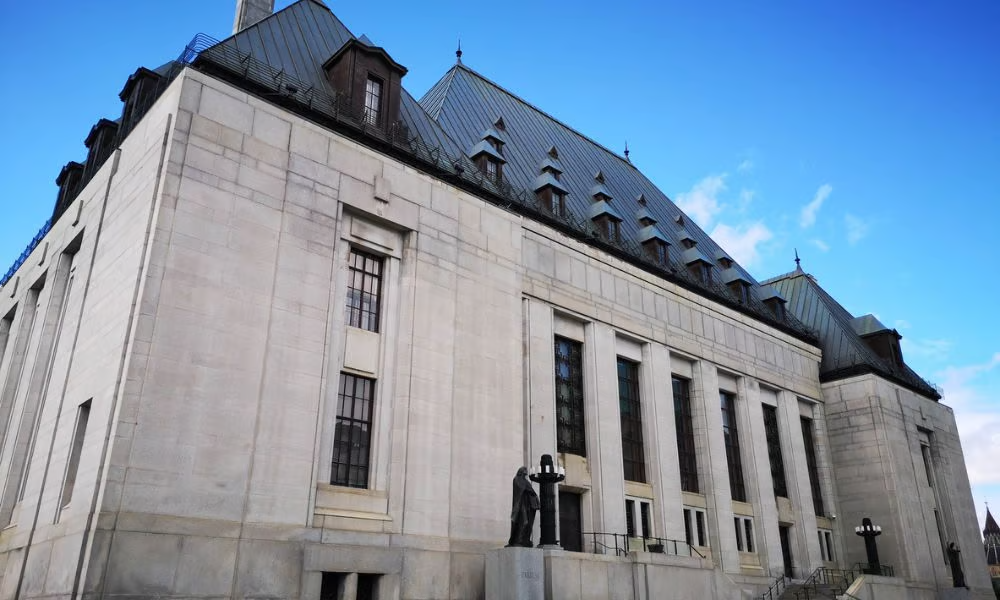
The Jordan rules come from the landmark Supreme Court of Canada decision in R. v. Jordan, 2016 SCC 27, which sets time limits on criminal court proceedings in a bid to address unwarranted and unconstitutional delay.
The second directive sees to it that the determination of s. 11 Charter applications is done in a timely way. Under this new rule, the hearing of an application must take place “at least four months before trial so that, if the application is granted and a stay of proceedings is imposed, the scheduled trial dates may be utilized for other matters.”
Among other things, s. 11 deals with the right to a timely trial and the protection of unreasonable delay in criminal matters.
The third, which applies only to courts in Toronto and Brampton, “establishes a standard 12-week adjournment for matters in which counsel is retained at an accused person’s first or second appearance in case management court.”
By the end of this adjournment period, both the defence and Crown should have finished the case management steps and be either ready to resolve the case or set a date for trial or preliminary inquiry.
“Reducing administrative appearances for counsel matters will shorten case management court dockets and permit the Court to spend more time addressing those matters which require more active case management,” states the announcement.
Additional details on the new directives can be found in the announcement.
If you have any information, story ideas or news tips for Law360 Canada, please contact Terry Davidson at t.davidson@lexisnexis.ca or 905-415-5899.
IRONICALLY THE LEGALIZATION OF CANNABIS HAS LED TO MORE INTRUSIVE SEARCH POWERS BY POLICE – “In Ontario, the transportation of marijuana is governed by the Cannabis Control Act, which allows the police, in the absence of any suspected criminal activity, to search any vehicle and all its occupants (if they believe that “any cannabis is contained in the vehicle” and it is “readily available to any person in the vehicle.”) It can’t be understated just how broad the new police search powers are – we are talking about searching anywhere in the vehicle, including the trunk, and all passengers and their belongings, down to the deep pockets, makeup bags, and yes, even bras. So, here’s the big question: if the purpose of the Cannabis Control Act is to make sure drivers don’t have access to cannabis while driving, what’s the deal with searching the vehicle’s trunk? It doesn’t quite add up.” And it gets worse …

The shame of the Law Society of Ontario | Gary Joseph

This Justice of the Peace lost her $165,000 per annum salary, retirement and benefits over getting involved in her son’s $85 and 3 demerit point traffic ticket. And she thinks there was nothing wrong with her conduct.

AN EMBARRASSING COVID DECISION WAS FINALLY CORRECTED.

THE MANDELA EFFECT – Our memories may be a “factually incorrect recollection. They could strongly believe in something, or strongly believe that they’ve had this experience or this memory, but in actual fact, it’s fantasy,”


THE MILTON COURTHOUSE UPDATE: Is it healthy and safe? Not so sure.

THE DISGRACE OF ONTARIO’S CRIMINAL JUSTICE SYSTEM -The old borough courts in commercial/industrial make-shift facilities were a disgrace. Now we have this. “Far too many people in the justice system held their breath during the pandemic, and saw all those virtual trials as a stop-gap to be endured until the old 19th-century model could return in all of its timeless glory.”
For too long, we’ve ignored the infrastructure of justice. Now, our court system is on fire
DAVID BUTT
PUBLISHED YESTERDAY
David Butt is a Toronto-based criminal lawyer.
Nobody walks into a home and oohs and ahhs about the electrical wiring. It’s stuff like the furniture and the kitchen counters that get the applause. But the boring old wiring can burn the place down instantly if it’s faulty and left uninspected. It cannot be neglected.
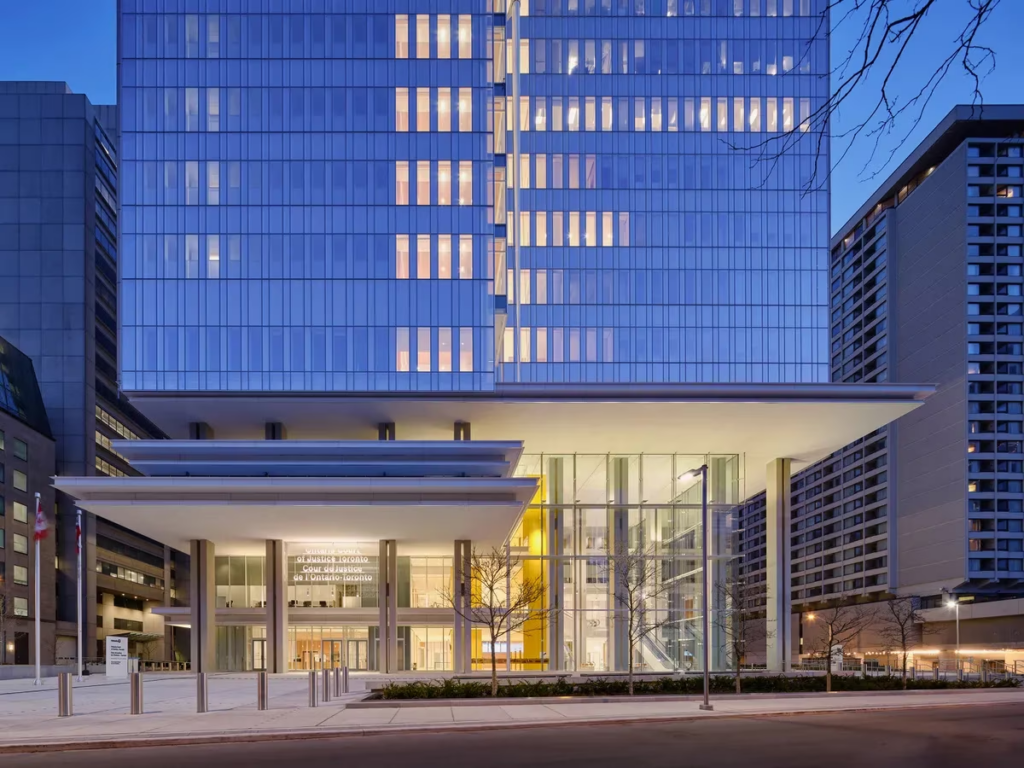
And now, Toronto’s brand-spanking-new billion-dollar courthouse is on fire, metaphorically speaking.
The Globe and Mail’s Sean Fine reports that courtrooms in the Ontario Court of Justice are closing by the bucketful because of staffing shortages. Trials are being delayed, and at risk of being thrown out altogether owing to unreasonable delay. What was supposed to be a criminal justice showpiece is now fully ablaze. And it’s because our creaky justice system – the electrical wiring of good governance in our society – has been left to moulder, tucked away from view.
The processes of the justice system – the thousands of trials and pleas handled by the courts every year, but also the diligent work done by court reporters, clerks and administrative staff – are largely invisible, and the general public doesn’t know much about it or give it much thought. Schools, roads, hospitals – the infrastructure we encounter regularly – these are the furniture and kitchen counters, and if they are substandard, we notice and complain. That’s important, because politicians listen to complaints, and direct money accordingly. When money is scarce (and it always is), it is not usually directed to things that don’t get much attention. Thus, what appears on the surface to be responsible democracy in action – politicians listening to the people – actually produces irresponsible governance. And so we routinely neglect our essential yet mostly invisible justice systems, until something catches fire.
The criminal justice system’s invisibility problem will never go away. Very few people, as a percentage of the total population, are unlucky enough to get caught up in it. And nobody would care much to trumpet the good news that scarce public funds were giving fair trials to those accused of doing terrible things: that wouldn’t rise to the level of a bragging point, much less a political talking point. But invisibility and irrelevance are two very different things; without prompt and fair trials, justice itself is at risk. And until political actors recognize this distinction, situations such as the Toronto courthouse crisis will continue to flare up with distressing regularity – and with heartbreaking outcomes for victims and their loved ones, who are denied justice.
It would be an oversimplification to say the staffing problems at the new Toronto Courthouse are explained entirely by neglect, of course. Bad timing and a failure of imagination also play a role.
The Ontario Court of Justice was conceived as a replacement for smaller, outdated facilities in Scarborough, Etobicoke, North York, and a few downtown locations. But sadly, the new courthouse, an architecturally striking monument to geographical consolidation, was constructed during the pandemic. The timing couldn’t have been worse: as a global crisis inspired us to harness technology in the name of decentralization, transforming hidebound concepts of geographically fixed workplaces, the Ontario government was essentially creating a monument to the 19th-century conception of the justice system, which had transitioned from in-person traditions to virtual trials. Now, with people required to show up in court as they did before the pandemic, courthouse workers who once enjoyed short commutes in Scarborough, Etobicoke, or North York have had their work-life balance disrupted by the need to commute downtown with no extra pay or benefit – and many have quit as a result.
There is no way back. Building new courthouses in North York, Etobicoke and Scarborough is a non-starter. But there is also no way back to blithely accepting a rigid pre-pandemic conception of justice – that it must be forever dispensed by gathering every justice participant in the same room for every case, all the time.
Far too many people in the justice system held their breath during the pandemic, and saw all those virtual trials as a stop-gap to be endured until the old 19th-century model could return in all of its timeless glory. That was an enormous failure of imagination. We made it through the pandemic, but it remade us as well. What it means to do important things in person, and when direct human contact is essential and when it is not, have become far more complicated and nuanced questions in the past three years. The justice system, for all its vaunted importance and grand traditions, simply cannot afford to stifle those questions with 19th-century bromides about in-person trials all in one place. Otherwise, more fires will break out like the one burning in Toronto right now.
See insights and ads
Like
Comment
Share