A former York Region lawyer “maintained an elaborate web of lies for years” as he gave his clients fake judicial orders and continued taking their money even though he was no longer working on their cases, a judge has found.
Ontario Court Justice Sandra Bacchus convicted Adam White of fraud and uttering forged documents in December in Newmarket; her written reasons were released earlier this month. In doing so, she took into account his testimony that he was dealing with mental health issues, but rejected his claims that he either didn’t provide the fake documents or didn’t recall doing so. A former president of the York Region Law Association, White was suspended by the Law Society Tribunal in 2023 and his licence was revoked the following year over the forgeries.
In one instance, White provided a client who was suing for wrongful dismissal with fake documents including orders from a judge and an email from the opposing lawyer offering to settle, when in reality the case had already been dismissed without the client’s knowledge.
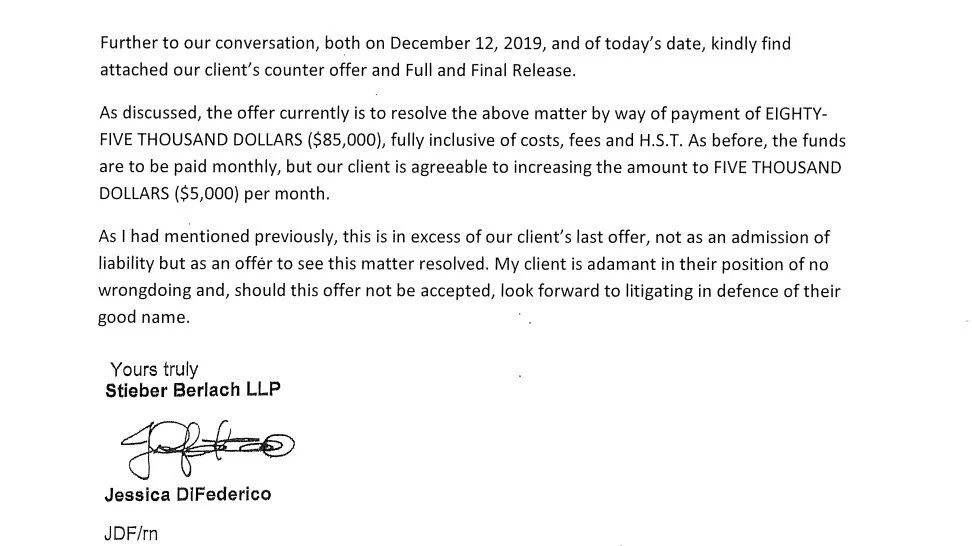
The fake letter from opposing lawyer Jessica DiFederico, dated Dec. 16, 2019, and including her law firm logo, offered to settle the case for $85,000 — “this is in excess of our client’s last offer, not as an admission of liability but as an offer to see this matter resolved.”
The letter partly contributed to the client’s desire to increase the amount of damages he was seeking. What he didn’t know was that his case had been dismissed in June 2019. He testified he only learned of that fact when he went to the courthouse in March 2023 to inquire about its status; not only was he told that the case had ended years ago, but that there was an outstanding costs award against him for $8,000.
A fake letter from an opposing lawyer in December 2019 offering to settle, when in reality the case had been dismissed months earlier.
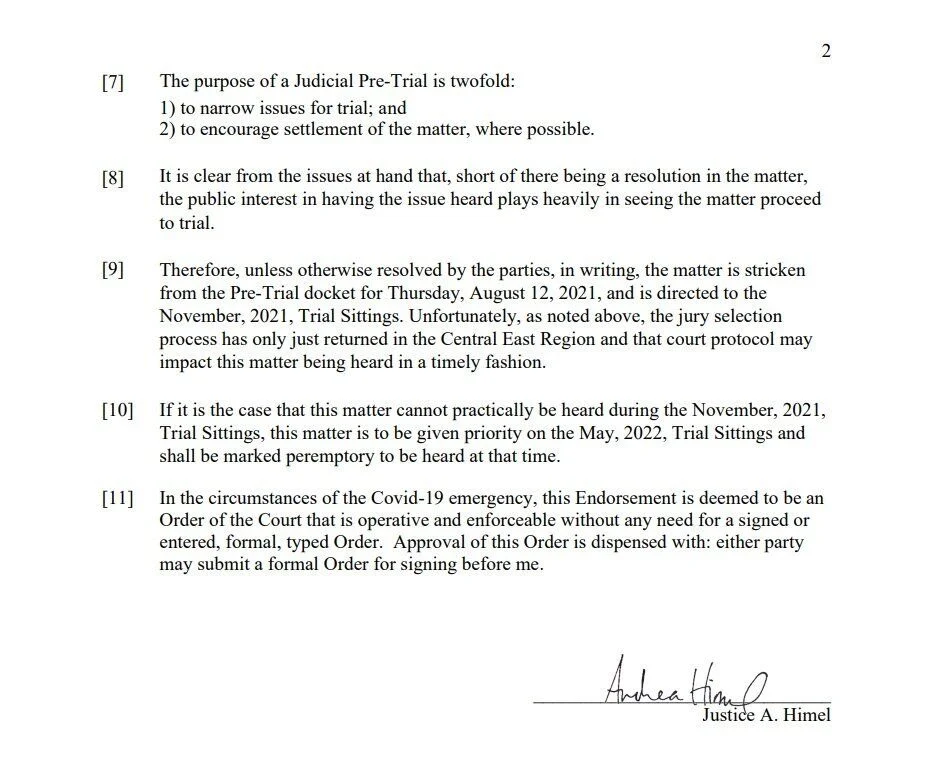
It was a surprise to the client, given that White had been emailing him throughout 2020 and 2021 suggesting the civil case was still active. White had also provided him with an endorsement that appeared to be signed by Superior Court Justice Andrea Himel and included a court logo, in which the judge purportedly ruled that the trial would be heard in November 2021, but may be impacted by delays related to COVID-19.
“The jury selection process has only just returned in the central east region and that court protocol may impact this matter being heard in a timely fashion,” says the fake Himel endorsement. “If it is the case that this matter cannot practically be heard during the November 2021 trial sittings, this matter is to be given priority on the May 2022 trial sittings.”
In November 2022, White sent his client another fake Himel endorsement, punting the trial to spring 2023. The client testified he paid White between $15,000 to $20,000 to handle his lawsuit; he said he paid $7,000 after the case was dismissed without his knowledge in June 2019.
Fake Himel endorsement
A fake endorsement with the signature of Superior Court Justice Andrea Himel.
In the second instance, White provided a number a fake judicial endorsements while representing a man in a child custody case between 2020 and 2022. The client testified receiving one of the endorsements from White in his Keswick office, with White telling him it was positive and the judge “appeared to be favouring his side.”
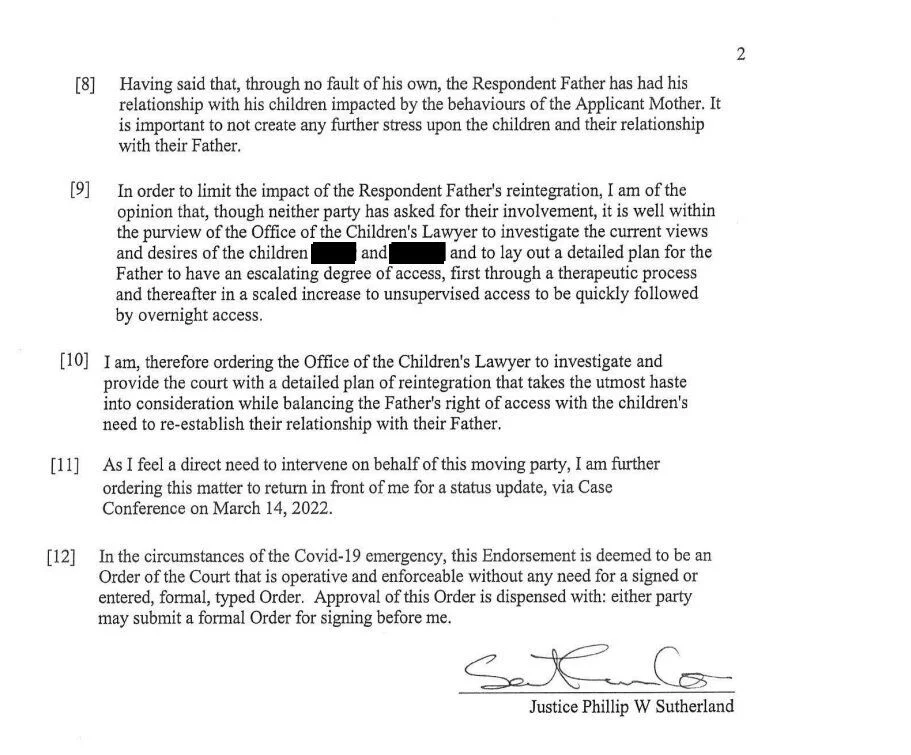
In the fake endorsement purportedly signed by Superior Court Justice Phillip Sutherland in February 2022, the judge wrote that it was “completely untenable” that the mother was frustrating the man’s access to his children, and ordered that the Office of the Children’s Lawyer investigate the current views and desires of the children to facilitate the father’s reintegration into their lives.
The man’s professional relationship with White ended in October 2022 when he was served with a contempt motion by his ex-wife’s lawyer for missing a court date he had no knowledge of. The man’s mother had been covering his legal fees, and testified she paid White an initial $5,000 retainer fee followed by several payments totaling over $11,000.
The judge specifically found that a payment of $2,825 made by the mother to White in June 2022 at the lawyer’s request, for what White descried as “future actions,” was money received “for court proceedings that had not occurred and were not scheduled” in 2022.
“She testified that she went to Mr. White’s office on multiple occasions to find out what was going on with the case when he was not replying to the emails, texts or phone calls, either she or her son sent to Mr. White,” Bacchus wrote in her judgment.
“She testified that on other occasions, Mr. White met her at the door of his office and told her he was working on it. However, on more than one occasion when she went to Mr. White’s office, she testified that he would come out of his office and say, ‘it’s good news,’ and then hand her and her son a document.”
White represented himself at trial. Testifying in his own defence, he said he didn’t have the required intent to defraud his clients due to mental health struggles. Bacchus found that he testified in “an incredible and unreliable fashion.” For example, when asked if he had sent a particular email, his response was typically “that he could not confirm, but he also could not lawfully or legally deny,” the judge wrote. And when asked about a particular fake judicial endorsement, he testified that “if he received an endorsement, he was obligated to provide it to his client.”
She also rejected a suggestion by White that his law clerk “was principally involved in passing off these false documents” to his clients without his knowledge.
“It defies credulity that Mr. White did not provide the emails and endorsements identified in these proceedings to his respective clients or does not recall doing so,” Bacchus wrote. “They created the appearance that the matters were moving ahead while also setting up what appeared to be barriers imposed by the court.”
The judge said she took White’s mental health issues into account, but he was nevertheless guilty of one count of fraud over $5,000, one count of fraud under $5,000, and two counts of uttering forged documents. She acquitted him on two counts of attempting to obstruct justice. A sentencing hearing is scheduled for next month.
“The picture Mr. White paints of not being able to function at all, not knowing or remembering what he was doing, or how documents came about because of his deteriorated mental state, and acting with only a singular motivation and intention to survive, is not credible,” Bacchus said.
White didn’t just give his clients fake documents, the judge stated.
“He answered questions and represented to them that he was engaged in their cases,” she wrote. “And he took their money.”